Selecting new flooring is an important and often difficult decision. When you enter a showroom and are confronted with rows of samples that look very similar. How do you choose? Knowing the types of laminate flooring is also a big step in order to get confident with your choice right away for your home.
Laminate is an excellent choice, they are popular and versatile and can be one of the most durable types. But, not all laminate is made the same. The “type” might describe a surface finish, a durability rating or how it’s installed. This guide will help you sort through the differences and understand what really matters so that you can find the type of floor that suits your lifestyle and budget.
The Anatomy of Laminate Flooring
But before we get to the types let’s look at what makes up a laminate plank. Call it a high-tech sandwich. Everyone has its own job.
- Backing:
The bottom layer of the carpet adds support and acts as a moisture barrier. - Core:
The middle, thick layer. It is usually constructed of High-Density Fiberboard (HDF) and gives the floor thickness and strength. - Design Layer:
A high-resolution image of wood, stone or tile. This is what makes the laminate look so realistic. - Wear Layer:
The top layer. This is a strong, rigid aluminum oxide coating that protects your flooring’s design layer from damage due to scratching, staining, and fading. The thickness of this layer is what contributes to the durability product’s floor.
So, now let’s see how these ingredients combine to give us the different kinds of laminate.
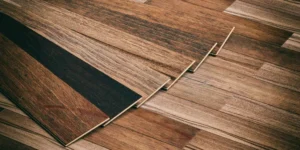
Different Types of Laminate Flooring on Surface Finish
The finish is what you can see and feel. It is going to drastically impact the visual appeal of your floor, how it receives foot traffic and simply how easy it will be to clean.
Smooth Finish
This is exactly what it sounds like. It is a perfect smooth shiny surface, no texture. It looks like newly sealed hardwoods or polished stone.
- Best For:
Low-traffic areas, such as a formal living room or bedroom. - Pros:
Easy to clean and sweep; bright, modern or elegant appearance. - Cons:
Slippery when wet. There is less of a plane to absorb wear and tear, so scratches and scuffs may stand out more on the perfectly flat face.
Textured Finish
A bit more than smooth, a textured finish has subtle dimples or waves pressed in. It brings a touch of realism and personality, breaking up reflections in the light.
- Best For:
Home offices and dining rooms that see moderate traffic. - Pros:
Shows minor dust and scratches less than on a smooth finish. Adds more visual depth. - Cons:
The texture can hold more of the fine dirt than a perfectly smooth surface.
Embossed Finish
This kind of finishing pushes texture a notch further. The embossing forming a relief of a grain or pattern that can be felt. But the pattern often is a random one and does not exactly correspond to the wood grain image formed in the design layer.
- Best For:
Family rooms and other areas where you want a realistic look without top tier price. - Pros:
Grippy grip and good at hiding imperfections. Feels more like real wood. - Cons:
They might start to not look as authentic with a more discerning eye given the texture of them compared to the image.
Embossed-in-Register (EIR)
This is the top shelf of finishes, and the apex of laminate realism. EIR Even with EIR, the texture stamped on the wear layer matches the printed image. If the picture reflected a wood grain, the texture followed that precise grain.
- Best For:
Any high-traffic space that prioritizes a luxe, authentic look. - Pros:
The most realistic wood and feel in a laminate. Great at concealing wear and tear. - Cons:
It is more expensive than other finishes.
Laminate Flooring Types According to Construction and Wear Layers
The way a floor is built will decide how it will or not endure your life. And this is where you have to be familiar with two important things. The AC Rating and water resistance.
Understanding the AC Rating
The Abrasion Class (AC) rating is the industry’s standard for rating the ability of a laminate floor to resist abrasion, impact and staining. It goes from AC1 to AC6. You’ll find AC3, AC4 and AC5 for residential use.
- AC3:
Design for all residential applications. Great for bedroom, living room, dining room, and light to moderate traffic areas. - AC4:
Suitable for all residential uses and medium commercial use. Perfect for busy kitchens, hallways and entryways. - AC5:
For the industrial heavy duty traffic, also well adapted for very intensive domestic use. This is your “bulletproof” choice for a home with large pets and lots of kids.
Waterproof vs. Water-Resistant Laminate
That’s the key differentiator in modern laminate flooring.
- Laminate With Water Resistance:
It’s common that regular laminates now come with a water-resistant top-coat. That is to say, it can manage a few small spills if they are wiped up immediately. But should water puddle on its seamed surface or in the grooves between boards, then the HDF core can swell and force the bowed edges of individual planks to lift. - Waterproof Laminate:
This is a game changer. Instead of HDF, these floors are constructed with a waterproof core, usually some form of a Wood Plastic Composite (WPC) or Stone Plastic Composite (SPC). Additionally, the seams feature a lock system that provides a completely solid, watertight connection. This floor can be installed in kitchens, bathrooms and other damp areas where you would not dare put traditional laminate.
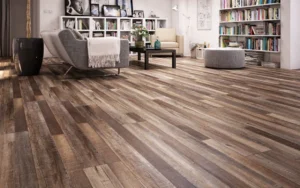
By Installation Method Style of Laminate Flooring
Finally, yes, you’d love it to be super water-resistant and also the way it’s installed is actually important, especially if you’re doing it yourself.
Glue-Less Click-Lock Flooring
This is the most popular form of installation currently. The planks feature a tongue and groove locking system on the ends. You just tilt the plank and snap it into the next one, where it solidly clicks in place.
- Pros:
Fast and easy to install; avoids messy glue; floors can be walked on immediately; can be easily disassembled and moved. - Cons:
Very flat and level subfloor is needed for the locking mechanism to function.
Glue-Down Flooring
This is the traditional application, where special adhesive is spread onto the subfloor and each plank placed in position.
- Pros:
Makes for a super solid floor that feels more like one solid surface. Less likely to move and squeak. - Cons:
Extremely difficult, time-consuming to install. It is messy work, and difficult to repair.
Making Your Choice
So, what is the best laminate flooring? It’s all up to you.
For the family kitchen where kids and pets abound? Opt for a water-resistant AC4-rated plank EIR finish.
For a clean, contemporary master bedroom? A smooth or a textured, AC3-rated floor would be ideal.
For a D.I.Y. job in a home office? A click lock, AC3 rated plank should be easy to install and hardy enough.
By knowing these basic varieties, you will be able to enter any show room feeling the good sense of being in control. You’re going to know exactly what you want after that to find a floor that not only looks stunning but can perform for years.
